About
Heterodox Research Society
Est. 2025
Reditus ad Naturam
To Think, Communicate, Engage
Founding
The history of science is a winding and wondrous path filled with distinguished characters, fascinating stories, and startling ambition, shaped over time by many different ways of seeing and engaging with the world.
Beneath this history sits our primitive instinct to make sense of the natural world. It is the urge to recognize patterns, construct causal stories, and orient ourselves within experience, that has guided human inquiry across history, long before formal disciplines or institutions gave us the behemoth structures of post-modern science that we have today.
As this instinct expresses itself over time, it takes on form through culture, language, and tools, gradually becoming a vast and fluid enterprise. Ideas rise and fall, paradigms intersect, and argument, rhetoric, and interpretation all contribute to what we come to understand as knowledge.
Heterodox Research Society was founded to engage with this broader view of science, one that recognizes its plurality and its fundamentally human character.
In the post-war era, the institutionalization of science introduced structure, scale, and coordination at an unprecedented level. At the same time, a gradual narrowing took place. A particular interpretation of a universal scientific method became dominant, and institutional incentives increasingly favored safety, repeatability, and legibility, often at the expense of exploration and speculation.
Over time, this has produced a form of methodological ossification.
The effects can be seen in the structure of modern research. Scientific activity has expanded dramatically, with more researchers, more funding, and an exponential increase in published work.
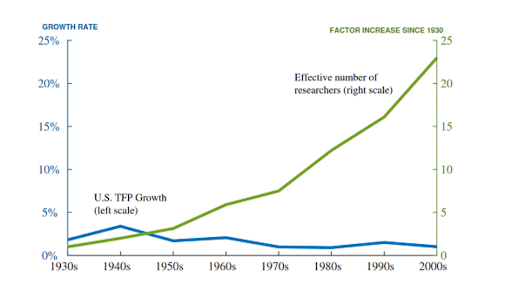
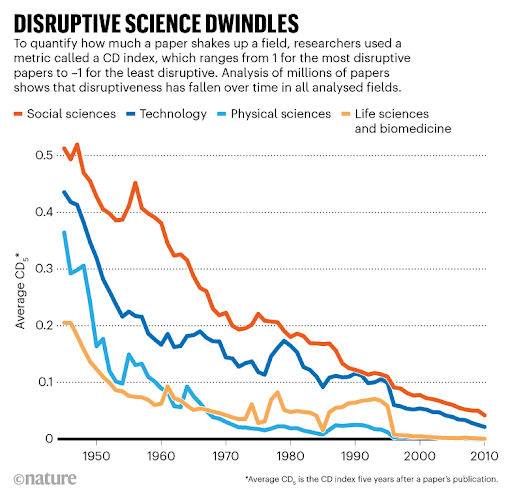
Looking beyond volume and toward substance, a different pattern begins to appear. The number of researchers required to produce meaningful advances has grown, and output per researcher and per dollar spent has declined in many areas.
"You see an exponential growth of scientific papers. So by that metric, you'd say things have never been better. The absolute number of researchers and engineers has never been larger. And even in proportion to the population, the fraction is also extremely large, has been booming. But when you look at the content, the substance of these papers, I could summarize in a bit of a pejorative way by saying these papers are mostly about well-dressed trivia. In many disciplines, in order to have the next increment, you need five or 10 times more researchers. So what we see is the production per dollar spent per researcher has been really decreasing. So that's clear; all metrics show this." — Didier Sornette, ETH Zurich
This reflects a structural condition within the system of science itself, and suggests a drift away from the more open and exploratory terrain upon which it historically developed.
Principles
We emphasize a set of principles, grounded in the philosophy of science, that orient our work towards a prosperous future.
Methodological Flexibility
Methodological flexibility is central to our view of science. We embrace fringe topics and welcome diverse approaches to inquiry, recognizing that there is more than one way of doing science. To seriously engage the question of methodology is to ask how one actually conducts work in the laboratory, and how different modes of thought shape the process of discovery.
Just as one may be guided by empiricism, others may be guided by intuition. Just as some may be driven by analytical rigor, others may be metaphysically inspired by the beauty of symmetry. Across the history of science, every methodological rule that has been proposed has been broken in the course of a meaningful discovery, often giving rise to entirely new ways of seeing and engaging with the world.
Men and women who explore the patterns of nature should not be bound by arbitrary methodological dogma. Science has never been guided by a single universal method, and instead unfolds as an opportunistic endeavor, one that demands adaptability, nimbleness, and epistemic humility. Flexibility in science is a virtue, and a necessary condition for discovery.
Openness
Openness may be expressed internally or externally, and is not confined solely to public transparency. While open-source science is a key point of emphasis in our work, there are many examples of meaningful progress occurring behind closed doors, where environments still allow for the convergence and contention of diverse perspectives.
At its fullest expression, openness is the overcoming of rigid domain specificity. It is an interdisciplinary mode of inquiry in which engineers may work alongside theorists, biologists alongside chemists, physicists alongside poets. What matters is the creation of environments where different forms of knowledge, intuition, and technique are able to meet, interact, and evolve together.
Such environments are often emphasized in principle, yet rarely instantiated in practice, and it is this deeper form of openness that we seek to cultivate.
Individualism + Self-Sufficiency
Science has always been carried by individuals, from all sorts of backgrounds and creeds, scattered across this world. Individuals who have mapped the skies, dissected the human anatomy, and broken apart the atom into its constituent parts.
It is through individuals that inquiry takes shape, and through their persistence, curiosity, and independence that discovery becomes possible. Such individuals must be supported, but they must also be capable of carrying themselves, able to think independently, to act, and to pursue lines of inquiry without total reliance on institutional structure.
A healthy scientific culture is one in which individuals are able to stand on their own, while still participating in a broader intellectual landscape, contributing to and drawing from a shared pursuit of understanding.
Mission
Our aim is to engage with the culture of science and help shape a future that is both aware of and grounded in its past.
We seek to create space for forms of inquiry that have been neglected or dismissed, to encourage flexibility in method, and to support individuals and small groups operating both within and outside traditional structures.
From this, new laboratories can emerge, new approaches to experimentation can take shape, and the pursuit of understanding can remain open to those willing to engage with it.
Reditus ad Naturam
Return to Nature
Deranged institutional incentives, lack of epistemic freedom, and cultural malaise have led us away from the natural state of inquiry. We must return science to its natural, radical, anarchic state - wonderful progress will ensue.
The Ordinary Mind & The Enlightened Mind
Symbolic of dialogue between two distinctive realms of understanding while also representing the constant tension between the infinite and the finite.
The Sextant
A tool which wrangles the celestial into the practical, symbolic of scientific methodology and the tools we use to navigate the unknown.
The Cosmic Bird
Representing freedom and exploration with cosmic orientation.
Founders
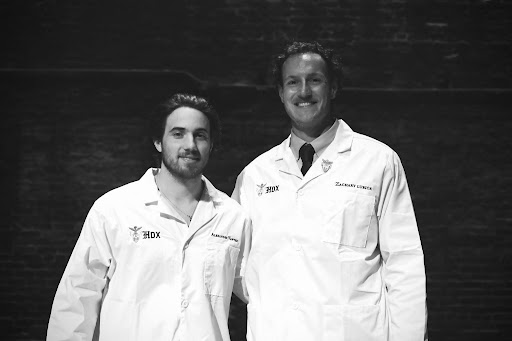
The Heterodox Research Society was founded in 2025 by Alexander Vawter and Zachary Lubick, longtime friends who came from distinct yet converging perspectives on the scientific enterprise. Zachary completed his M.S. in Chemical Engineering at NC State and worked professionally in carbon capture and applied chemistry, while Alexander approached science through independent study in the history and philosophy of science alongside experience in software, data analytics, and biological research.
Together, they founded the Society around a shared belief that the deeply human, creative, and anarchic spirit of science must be preserved, and that the future of science will not simply flourish on its own without individuals and ideas willing to cultivate new frontiers of thought, experimentation, and discovery.
About
Heterodox Research Society
Est. 2025
Reditus ad Naturam
To Think, Communicate, Engage
Founding
The history of science is a winding and wondrous path filled with distinguished characters, fascinating stories, and startling ambition, shaped over time by many different ways of seeing and engaging with the world.
Beneath this history sits our primitive instinct to make sense of the natural world. It is the urge to recognize patterns, construct causal stories, and orient ourselves within experience, that has guided human inquiry across history, long before formal disciplines or institutions gave us the behemoth structures of post-modern science that we have today.
As this instinct expresses itself over time, it takes on form through culture, language, and tools, gradually becoming a vast and fluid enterprise. Ideas rise and fall, paradigms intersect, and argument, rhetoric, and interpretation all contribute to what we come to understand as knowledge.
Heterodox Research Society was founded to engage with this broader view of science, one that recognizes its plurality and its fundamentally human character.
In the post-war era, the institutionalization of science introduced structure, scale, and coordination at an unprecedented level. At the same time, a gradual narrowing took place. A particular interpretation of a universal scientific method became dominant, and institutional incentives increasingly favored safety, repeatability, and legibility, often at the expense of exploration and speculation.
Over time, this has produced a form of methodological ossification.
The effects can be seen in the structure of modern research. Scientific activity has expanded dramatically, with more researchers, more funding, and an exponential increase in published work.
Looking beyond volume and toward substance, a different pattern begins to appear. The number of researchers required to produce meaningful advances has grown, and output per researcher and per dollar spent has declined in many areas.
"You see an exponential growth of scientific papers. So by that metric, you'd say things have never been better. The absolute number of researchers and engineers has never been larger. And even in proportion to the population, the fraction is also extremely large, has been booming. But when you look at the content, the substance of these papers, I could summarize in a bit of a pejorative way by saying these papers are mostly about well-dressed trivia. In many disciplines, in order to have the next increment, you need five or 10 times more researchers. So what we see is the production per dollar spent per researcher has been really decreasing. So that's clear; all metrics show this." — Didier Sornette, ETH Zurich
This reflects a structural condition within the system of science itself, and suggests a drift away from the more open and exploratory terrain upon which it historically developed.
Principles
We emphasize a set of principles, grounded in the philosophy of science, that orient our work towards a prosperous future.
Methodological Flexibility
Methodological flexibility is central to our view of science. We embrace fringe topics and welcome diverse approaches to inquiry, recognizing that there is more than one way of doing science. To seriously engage the question of methodology is to ask how one actually conducts work in the laboratory, and how different modes of thought shape the process of discovery.
Just as one may be guided by empiricism, others may be guided by intuition. Just as some may be driven by analytical rigor, others may be metaphysically inspired by the beauty of symmetry. Across the history of science, every methodological rule that has been proposed has been broken in the course of a meaningful discovery, often giving rise to entirely new ways of seeing and engaging with the world.
Men and women who explore the patterns of nature should not be bound by arbitrary methodological dogma. Science has never been guided by a single universal method, and instead unfolds as an opportunistic endeavor, one that demands adaptability, nimbleness, and epistemic humility. Flexibility in science is a virtue, and a necessary condition for discovery.
Openness
Openness may be expressed internally or externally, and is not confined solely to public transparency. While open-source science is a key point of emphasis in our work, there are many examples of meaningful progress occurring behind closed doors, where environments still allow for the convergence and contention of diverse perspectives.
At its fullest expression, openness is the overcoming of rigid domain specificity. It is an interdisciplinary mode of inquiry in which engineers may work alongside theorists, biologists alongside chemists, physicists alongside poets. What matters is the creation of environments where different forms of knowledge, intuition, and technique are able to meet, interact, and evolve together.
Such environments are often emphasized in principle, yet rarely instantiated in practice, and it is this deeper form of openness that we seek to cultivate.
Individualism + Self-Sufficiency
Science has always been carried by individuals, from all sorts of backgrounds and creeds, scattered across this world. Individuals who have mapped the skies, dissected the human anatomy, and broken apart the atom into its constituent parts.
It is through individuals that inquiry takes shape, and through their persistence, curiosity, and independence that discovery becomes possible. Such individuals must be supported, but they must also be capable of carrying themselves, able to think independently, to act, and to pursue lines of inquiry without total reliance on institutional structure.
A healthy scientific culture is one in which individuals are able to stand on their own, while still participating in a broader intellectual landscape, contributing to and drawing from a shared pursuit of understanding.
Mission
Our aim is to engage with the culture of science and help shape a future that is both aware of and grounded in its past.
We seek to create space for forms of inquiry that have been neglected or dismissed, to encourage flexibility in method, and to support individuals and small groups operating both within and outside traditional structures.
From this, new laboratories can emerge, new approaches to experimentation can take shape, and the pursuit of understanding can remain open to those willing to engage with it.
Reditus ad Naturam
Return to Nature
Deranged institutional incentives, lack of epistemic freedom, and cultural malaise have led us away from the natural state of inquiry. We must return science to its natural, radical, anarchic state - wonderful progress will ensue.
The Ordinary Mind & The Enlightened Mind
Symbolic of dialogue between two distinctive realms of understanding while also representing the constant tension between the infinite and the finite.
The Sextant
A tool which wrangles the celestial into the practical, symbolic of scientific methodology and the tools we use to navigate the unknown.
The Cosmic Bird
Representing freedom and exploration with cosmic orientation.
Founders
The Heterodox Research Society was founded in 2025 by Alexander Vawter and Zachary Lubick, longtime friends who came from distinct yet converging perspectives on the scientific enterprise. Zachary completed his M.S. in Chemical Engineering at NC State and worked professionally in carbon capture and applied chemistry, while Alexander approached science through independent study in the history and philosophy of science alongside experience in software, data analytics, and biological research.
Together, they founded the Society around a shared belief that the deeply human, creative, and anarchic spirit of science must be preserved, and that the future of science will not simply flourish on its own without individuals and ideas willing to cultivate new frontiers of thought, experimentation, and discovery.